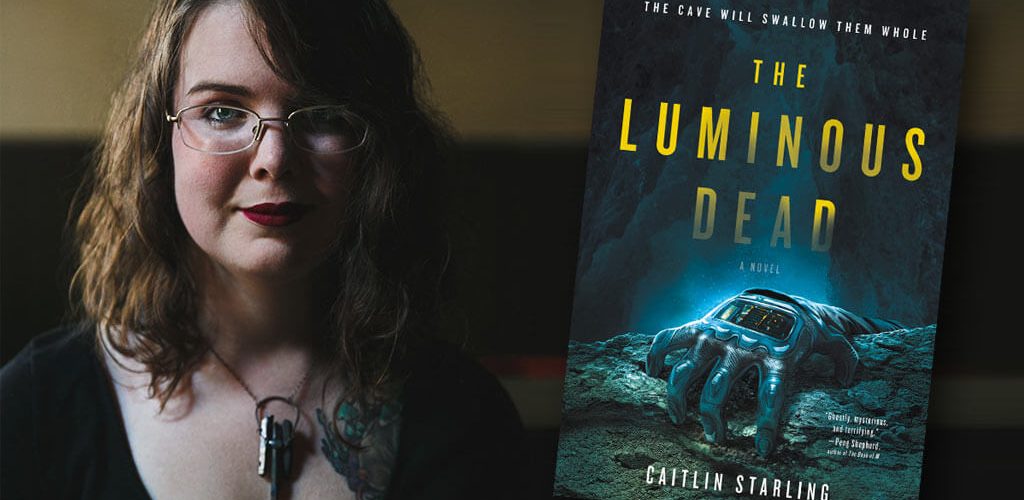
Given how much of 2020 has progressed so far, I could forgive myself for reading “comfortable” books; the kind that would help me deal with and take me away from this constant feeling of existential dread and anxiety. But if you scroll down my Goodreads list, you will see I’ve read very few books you could describe as “comfortable” (with the greatest respect to authors who cater for that market: it’s much needed). At the end of the day, all the books I’ve read this year so far have captured the essence of humanity: it’s hopes and dreams, its triumphs and failures, its birth and its death. One such book has stood out this year, and is a perfect example of what it takes to be human and to survive against hopeless odds, is The Luminous Dead, the debut novel from American author Caitlin Starling.
Set on another planet, in a far-flung dystopian future, The Luminous Dead is a book about Gyre Price, a potholer who was raised on a mining colony. She lies about her experience and credentials and basically bluffs her way into a high-stakes job offering the kind of money to help her get off-planet and find her mother, who abandoned her years earlier. Gyre has issues, but then again so does her handler, Em, who literally pulls Gyre’s strings from above-ground. Gyre and Em need to trust each other, but it’s plain from the off that they don’t. And this mistrust could get Gyre killed. Or worse: she could become a ghost, destined to haunt the caves until the next expedition comes around.
This isn’t Em’s first attempt to find the rich mineral deposits in these caves. Without giving too much away, Gyre’s handler has other deeply personal reasons in urging her charge downwards and into danger. Constant gear malfunctions, missing supplies, and the supremely creepy presense of Tunnellers, subterranean creatures who dwell in the shadows and can literally pop up anywhere, add to the notion that Gyre might not make it out in one piece, if at all.
The Luminous Dead sticks with Gyre’s POV throughout, without making it a first person narrative. This is a difficult form of storytelling to pull off, the challenge being that the author needs to keep the reader engaged with both the action around the main character and her innermost thoughts. And this won’t be for everyone. Readers expecting a balls-to-the-wall action adventure along the lines of Alien and Neil Marshall’s 2005 horror movie set in a cave, The Descent, will come away feeling short-changed. So it’s important to note that while there are plenty of death-defying sequences within the book, this is equally a two-hander piece of speculative fiction that keeps the story moving forward because we are so invested in Gyre and Em. These are young women, at times working with and against one another, but with a similar endgame in mind. It’s a human thing in times of crises to fall into distrust and disbelief, but when it comes to the crunch, inevitably we have to trust someone, even if that someone is ourself.
Caitlin Starling: The Luminous Dead
The Luminous Dead is rich in atmosphere, and is in equal parts a science fiction thriller, a horror story, a psychological drama, and — yes — a delightfully queer love story. As debuts go, Caitlin Starling has put herself on the map, with her novel nominated for a Locus Award, a Bram Stoker Award, and winner of the Ladies of Horror Fiction Award for Best Debut Novel. She recently released Yellow Jessamine, a dark fantasy novella that I will no doubt read and review in the very near future.
I picked a bad time to read a series of books about a Europe ravaged by the after-effects of a global pandemic, a refugee crisis, terrorism, and the break-up of the EU itself. But here we are. Dave Hitchinson’sFractured Europesequence is the ultimate in literary What If? for our time. Allow me to take you through this quartet, and introduce you to Rudi.
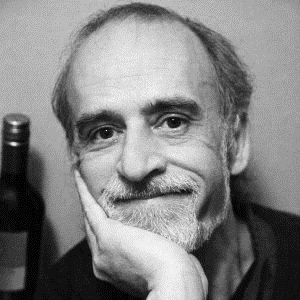
Dave Hutchinson (Image: us.macmillan.com)
An Estonian, working in a restaurant in Krakow, Rudi’s exceptional talents keep him gainfully employed in an economy that’s pretty much gone to hell. One evening at the restaurant, Rudi is approached by a representative of an underground organisation called the Couriers des Bois. His nationality could be of use to them, and they need someone to move a package across the many borders across the continent. Europe has become so segmented over the years that practically any entity, be it a statelet or national park, can declare independence and have its own border control process.
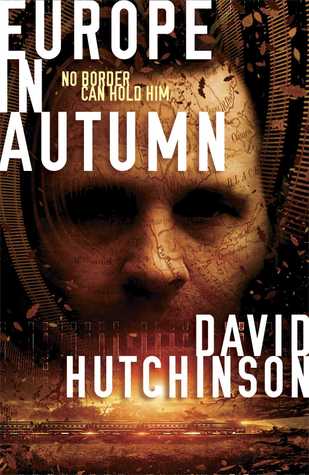
In Europe in Autumn, Rudi goes from being a cook to a spy. It’s impossible to swat away John le Carre vibes here. Rudi has to learn as he goes, and although he has support from the organisation, he’s very much on his own for much of the novel. His instructor/mentor is MIA, presumed traitorous. And his friends and family become targets of whomever is behind the “Great Conspiracy”. And oh, what a conspiracy it is!
Sometime in the 19th century, a family of English cartographers, map-makers, brought into existence a parallel Europe, and somehow this Europe, populated in the main by English people, and accessible from very few places in our Europe. Yes, it’s a head-scratcher. Dave Hutchinson moves from near-future spy fiction to the realm of fantasy. And it works, because throughout the book, we see everything through Rudi’s eyes. We’re as flummoxed as he is, but there’s a job to do and people to protect, so like James Bond and George Smiley, we want to get to the bottom of this mess.
Europe at Midnight takes us to the Campus, a university nation-state that’s both within and without the Community, the parallel Europe. It’s also the site where the flu virus was manufactured, and there’s also a nucleur weapon. Rudi has very little to do in this instalment, instead we follow Jim, who works for British intelligence. A stabbing on a London bus begins the intrigue, and in a story where the chronology of events has to be worked out by the reader, it’s a captivating puzzle that when worlds finally collide, some questions are answered, but inevitably many more take their place.
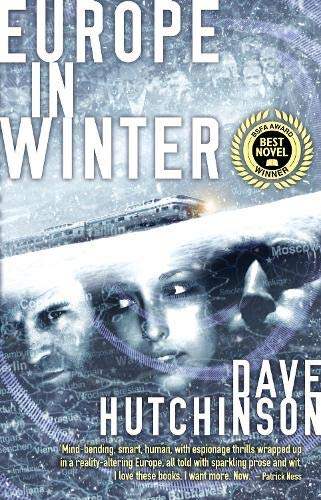
Europe in Wintersees the return of Rudi. It opens with the suicide bombing of an important railway tunnel operated by the Line, a network that crosses continental Europe and is a nation state itself. Think Amtrak, but you need a passport and travel documents to board. Awareness of the Community is widespread, and diplomatic relationships are struck up between the different European universes. Characters from previous books make an appearance, and the action includes assassinations, perilous travels between worlds, and a revision of history as we know it. There’s a wonderful sequence of events at the end involving an airport that I will not spoil here. You will have to read it for yourself.
In the last (presumably, but with Dave Hitchinson you never know) of the sequence, Europe at Dawn, there is a resolution of sorts for the disparate storylines, but also gives space to introduce new and important characters. There is murder, mayhem, chases, and escapes. There is a sublime subplot about a bejewelled skull in the possession of a travelling folk group that by the end of the book, it all makes some sort of sense. But not everything gets resolved; there’s no “and they all lived happily ever after”. But I remain very much okay with that.
The above summaries do little justice to the themes and events that run throughout Fractured Europe. I need to point out that at times, the books are very funny. There’s an almost Terry Pratchett feel to them. Dave Hutchinson’s attention to detail and knowledge of world and European history permeates each page and character. The new future world of which he writes is grey and mundane, but the story is rich in atmosphere. If John le Carre were to write speculative fiction as a spy story, he could not do a better job than Dave Hutchinson. He is a writer for and of our times.
I spent much of the early part of this year reading James S.A. Corey’s Expanse series, ploughing through books two to eight in a couple of months. Now, like all fans, I eagerly anticipate the final book, Leviathan Falls, which is due out some time in 2021. I’ve been on the lookout for other series to take its place, and I know there are plenty out there, but I felt a need for character-driven space opera rather than out-and-out humans-v-aliens action adventure. Becky Chambers‘ Wayfarers series was always on the cards as a must-read, and now I’m wondering why it took me so long to get there.
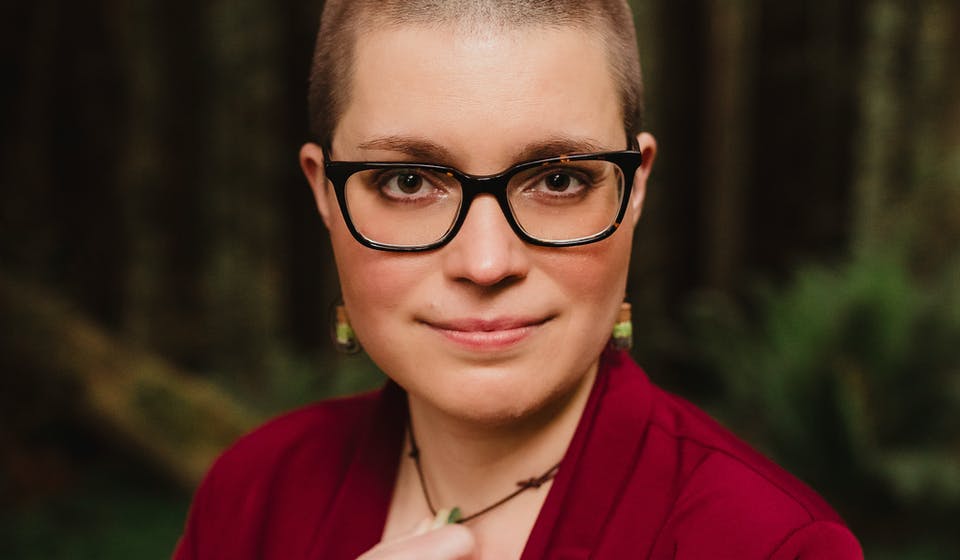
Becky Chambers (Image: Hatchette.com.au)
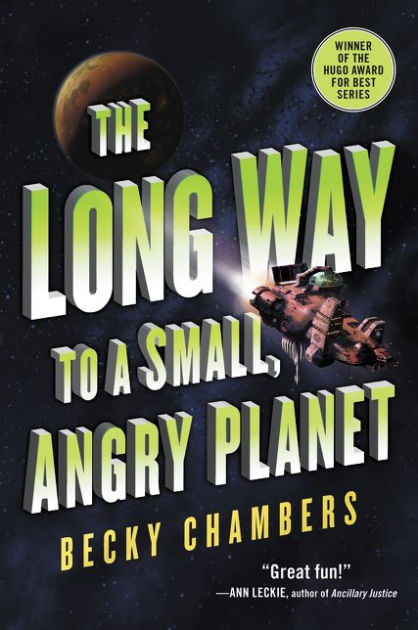
Wayfarersis a four book series, beginning with The Long Way To A Small Angry Planet. Published in 2015, originally via a Kickstarter campaign, Becky’s debut found its audience and was nominated for major prizes, such as the Arthur C. Clarke Award, the Women’s Prize for Fiction, and the British Fantasy Awards. It was also the first self-published novel to be nominated for the Kitschies, which “rewards the year’s most progressive, intelligent, and entertaining fiction that contains elements of the speculative or fantastic.” In short, publishing dynamite. The reasons for this are plentiful.
Image: Barnes & Noble
Ashby Santoso is the captain of the Wayfarer, a ship that creates tunnels through space, wormholes basically, allowing access to distant planets, galaxies, and markets. This function is vital to the stability and economy of the Galactic Commons (GC), a federation in which Humanity is its most recent member. Ashby understands that a ship is only as good as its crew, and in this regard, his crew is the most diverse, talented, unique, and loyal group of people the GC has ever mustered up.
Joining the team is Rosemary Harper, and she serves as our introduction to both Becky Chambers’ universe and its inhabitants. Rosemary enlists as a file clerk under false pretenses. She’s on the run from her past, but at the same time wants to see what else is out there. Luckily enough she is good at her job, even if her presence riles Artis Corbin, the ship’s algaeist. He has the important job of growing the ship’s fuel and nothing or no one else is really important to him. Also on board is Sissix, an Aandrisk, who along with Ohan, a Sianat Pair, pilot and navigate the Wayfarer. Jenks and Kizzy are the ship’s technicians, with Jenks enjoying a very special and beautiful relationship with the ship’s AI, Lovelace, AKA Lovey. Rounding off the crew is Dr Chef, a Grum, who also serves as a kind of therapist for his shipmates.
The main thrust of Small Angry Planet is the crew’s mission to tunnel a wormhole through to a new system that has been granted provisional membership of the GC. It’s a journey that will take some time, a ‘standard’, which I believe is more than a year. The passing of time is denoted differently to ours: where we would say week, the citizens of the GC say tendays, which I think is self-explanatory. The trek is not without its perils. The Wayfarer encounters space pirates, heretics, and saboteurs. But action doesn’t drive the plot; it’s characters do.
Along the way we get to know the crew through beautiful and surprising revelations. The story is told in multiple POVs, but never once does Becky Chambers lose clarity in voice or thought. While not an action-orientated adventure, the set-pieces when they come are dramatic, and often reveal depths to each of the characters in the novel. Their individual stories are the bedrock upon which the author sets her stall, and they are in turn inspiring, poignant, heart-breaking, and despite the presence of alien beings, so very human.
This is a story about family, and not just the one we’re born into: it’s about the family we chose for ourselves as we travel through life and the stars. Rosemary’s secret, when it does come to light, doesn’t affect how the crew sees her as a person, but it becomes a way for her to grow more into herself, and her relationship with Sissix especially is more powerful as a result.
Image: Geekdads
The events at the end of Small Angry Planet allows Becky take us down another path. Book two in the series, A Closed And Common Orbit, is effectively a stand-alone sequel, with the focus on Lovelace, the AI, who takes human form, an action that is illegal in the GC. Lovelace’s new body, or “kit”, has its advantages and disadvatages, and through the course of Common Orbit, we see her and her friend Pepper, a friend of Jenks who comes to the ship’s rescue in the previous novel, negotiate the new normal. Two stories run concurrently. Lovelace’s search for the meaning of existence as she seeks to understand the importance of intimate relationships, as well as having a program that forbids her to lie, is the inital focus. Learning to bend the truth a little bit is vital for her survival. Pepper’s story is equally relevant, and we discover how she came to be. When Owl is introduced, I read her voice as one of my very dearest friends, and she gave me great comfort. I’m not ashamed to say that I found Pepper’s story very emotional and how the two strands in the novel work out hit me in my core. Pepper’s best friend, Blue, is magnificent. And Tak, Lovelace’s friend and tattoo artist, completes this fantastic four.
Book three has a different approach altogether. Record Of A Spaceborn Few choses as its focus five characters who live on board a generation ship that’s part of the Exodan Fleet, among them Tessa, the sister of Captain Ashby Santoso from Small Angry Planet. The Fleet represents what’s left of Humanity after it left Earth when it became uninhabitable. Granted GC citizenship and given a star of its own to orbit, the Exodan’s journey has come to an end. But what happens now? Spaceborn Few follows five main characters as they deal with the aftermath of a major catastrophe that occurs in the novel’s prologue. Apart from Tessa, we inhabit the lives and innermost thoughts of Isabel, the Fleet’s archivist, who is playing host to a visiting Harmaegeon, a GC elite who wishes to learn about the Fleet and Humanity; Eyas, a “caretaker’, who respectfully and ritualistically deals with the bodies of those who have died (basically turning them into compost); Kip, a teenage boy who wants nothing more than to leave the Fleet as soon as he’s able to; and finally Sawyer, a man who comes from the “bad side of town” and joins the Fleet looking for a new life.
Image: Author’s website
Like the preceding books in the series, Spaceborn Few has a theme. Small Angry Planet is about family. Common Orbit is, I think, about identity: who we are, how others perceive us, and how we preceive ourselves. Spaceborn Few is about home. Wherever it is, can we be happy there? Can we find our truth and our heart, or do we need to look further ahead? Will we ever find acceptance among people who are not us? Sometimes its not enough to just have a place to live; we need a place to be and to connect. Becky Chambers’ forte is getting inside her character’s heads. In learning so much about them, we find out similar things about ourselves and our humanity. It’s a beautiful thing, but it’s not always comfortable to read home truths.
Becky Chambers’ Wayfarers series is a beautifully written and deeply personal work of literary and speculative fiction. It probably won’t appeal to readers who like an explosion or gun battle every second chapter, although there are some great examples of both throughout all three books. It does, however, speak to the individual on what it means to be alive during times of crises and uncertainty. Each book found a place in my heart, and with a fourth and possibly final novel, The Galaxy, and the Ground Within, due out in 2021, it looks like I’ll have to find more room. Winner of the 2019 Hugo Award for Best Series,Wayfarers is majestic, epic in scope, but initmate in focus. It speaks to the human in each of us.
The website CrimeReads has become a veritable cornucopia: a treasure trove of authors, genres, concepts, covering all four corners of the world of detective, mystery, and thriller fiction. Long before this blog came into being, I scoured CrimeReads looking for new books to explore and new authors to follow. It’s how I found out about many of the authors you’ll read about here, including Rachel Howzall Hall and Kellye Garrett.
Martin Edwards (Image: Goodreads)
Martin Edwards has become my newest obsession. I grew up on Agatha Christie and Dorothy L Sayers. Later on, I read Ruth Rendell and PD James, favouring the more erudite detective, looking for perhaps the modern Sherlock Holmes. Now, I know no one can take Holmes’ place in the detective fiction Hall of Fame; so much so that many authors, including Anthony Horowitz, continue his adventures for emerging generations, thanks to the BBC’s Sherlock and CBS’s Elementary. But a lot of authors choose to set their mysteries in a similar era to the aforementioned greats. Mr Edwards is one of them.
Welcome to the strange and unsettling world of Rachel Savernake, a wealthy heiress and amateur sleuth. Set in and around London of the 1930s, Gallows Court harks back to the Golden Age of Detective Fiction, hitting the ground running with an assortment of gothic characters and atmosphere. Indeed, as you work your way through the pages of this book, you can almost smell the gas from the streetlamps and hear the hooves of horses as carriage hurtle through a fog-filled city. So far, so very comfortable for Holmesians alike. I felt at home.
(Image: Goodreads)
Rachel Savernake is the enigmatic daughter of a notorious hanging judge, and the story of her childhood on the island of Gaunt in the Irish Sea, as well as her frosty relationship with a girl named Juliet Bretano, runs concurrently with the main plot of the novel: in which a journalist, Jacob Flint, new to London and intent on making a name for himself as a crime reporter, is both helped and hindered by Rachel when their separate investigations of a series of bizarre and gruesome murders and apparent suicides result in a meeting of minds and resources.
It’s important to note that every character in Gallows Court is vital to the story. From the flashback events on Gaunt to the newsrooms of The Clarion, the paper Jacob writes for; from the backstreet hovels, to the secluded London mansion that Rachel calls home, no detail, no person, is wasted. Nothing is thrown away. I was glued to each page and couldn’t wait to finish, because there was a second book to hit up: Mortmain Hall.
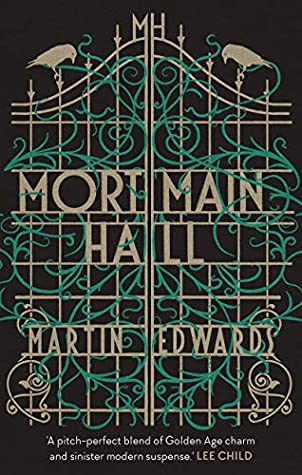
It’s not a spoiler to reveal that both main players, Rachel and Jacob, live to solve another case. And this is yet another violent conundrum that is more cross-country than Gallows Court, with the bulk of the action taking place at the eponymous Mortmain Hall, owned by Leonora Dobell, a criminologist obsessed with murderers who appear to have gotten away with their crimes. She enlists Rachel’s help. The heiress is intrigued because her attempt to prevent the murder of Gilbert Payne, a man presumed dead who returned to England for his mother’s funeral, ended in failure. Leonora’s invitation to Rachel to attend a weekend at the Hall provides her and Jacob with the key to unlock several mysteries.
(Image: Goodreads)
Rachel knows much more than she ever lets on to Jacob. In fact, only her inner circle of attendants know the full script in advance. Every twist in the story, when you think about it after, is cleverly foreshadowed in the pages of both books. Gallows Court sets up Martin Edwards’ universe, and then Mortrain Hall picks up the already frenetic pace and has an absolute ball with political conspiracies, secret societies, identity theft, and a million different gruesome ways to die. Unlike most Golden Age detective fiction, the blood is on the page, but these are not gratuitously violent books. A lot of the dialogue is tongue-in-cheek, and the main characters possess a sense of justice that is both charming and blood-curdling.
Martin Edwards was recently awarded the Crime Writers’ Association Diamond Dagger for sustained excellence in the genre. Up unti a month or so ago, I had never read his work. Now, for sure, I will eat up whatever I can get my hands on. Do yourself a favour, if you love your detective fiction historical and bloody, grab these books with both hands and enjoy the mayhem.
Check out Martin’s website, too. It’s a feast of articles, advice for writers, and you might as well take a look at his new non-fiction book, The Golden Age of Murder, a must-have for detective fiction fans everywhere.
My previous post recommended Rachel Howzell Hall’s new novel, as well as her back catalogue (seriously, why are you waiting?). Another Black writer to feature on BestBub’s 100 Best Crime Novels Of All Time is Kellye Garrett. Eight years of working in Hollywood, including writing for the TV show Cold Case gave Kellye an insider’s view on the rat-race that is entertainment’s premier capital town. Like Rachel, Los Angeles is in Kellye’s heart, blood, and soul.
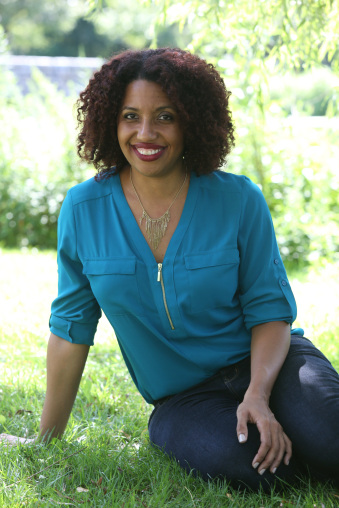
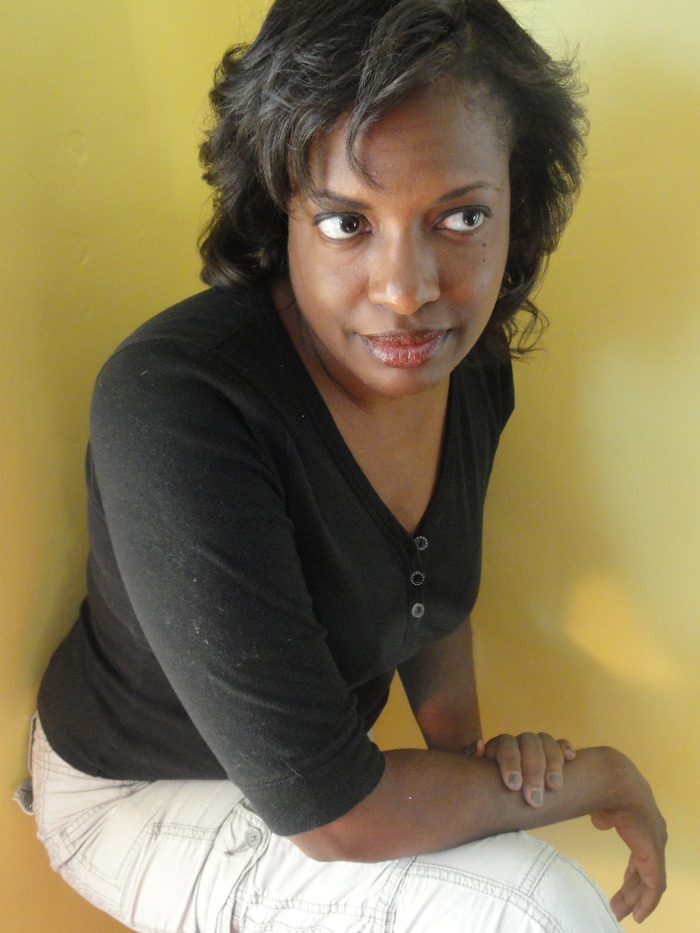
Kellye Garrett (Image: author’s website)
Her two books to date feature Dayna Anderson, an actress who was well known for being the face behind the Chubby Chicken commericals (I don’t think so, boo!), and is consistently almost recognised wherever she goes (Didn’t we go to high school together?). Now broke and unable to afford gas, Dayna has taken up residence in a room the size of a closet at her best friend Sienna’s apartment. She’s a proud woman who refuses to capitalise on her fame, instead she’s focusing on how she can save her parents’ home from going into foreclosure.
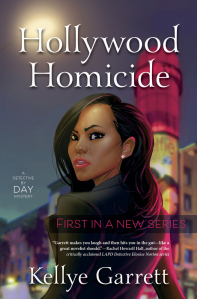
An opportunity arrives in the form of a billboard asking for information on the hit-and-run death of local shop worker Haley Joseph. As luck would have it, on the night of the incident, Dayna and her friends were witnesses to what would turn out to be murder. There’s a $15,000 reward offered for any imformation that leads to apprehension and conviction. So Dayna decides there and then to become an amateur sleuth. This is the premise for the first Detective By Day novel, Hollywood Homicide.
We are introduced to Dayna’s friends. Sienna I’ve mentioned briefly, but she’s a hoot. Chasing Instagram likes and trolling Twitter feeds for gossip, Sienna opens doors that were once held open for Dayna, as well as casting off her considerable collection of shoes and clothes to Dayna once she’s done with them. With an ego the size of a small planet, Sienna is ever-present at Dayna’s side, even when they fall out (which is a lot over the two books). Emme is more than just a computer nerd: she’s the anti-social twin sister of Oscar-nominated actress Toni Abrams, and deserves a series devoted to just her. Omari Grant is Dayna’s on-again-off-again boyfriend. Now the leading man of a cop show franchise, Omari and Dayna’s relationship hits more hurdles than an out-of-shape athlete, but the spark (once it hits) is dynamite. Completing the main cast is Aubrey S. Adams-Parker, an enigmatic ex-cop with a weird taste in orange reflector suits, who may or may not be in need of a partner.
And that’s not all. Add in Nina, Omari’s agent and (in book two, Hollywood Ending) a murder suspect, and The Voice at the other end of the police tip-line, the wonderful support cast is complete. Suspects come and go — sometimes permanently gone — but the core group doesn’t change over the two books.
Hollywood Ending gives us a front-row seat at the Silver Sphere Awards, where Omari is nominated as Best Actor. When Lyla Davis, a publicist for Silver Sphere is killed at an ATM robbery, Dayna and her team have a crack at solving it. It’s a more complex investigation than Hollywood Homicide, and when the situation calls for it, the potential for slapstick comedy, about-turns, mortal danger, and snappy dialogue is heightened to a fantastic level.
What I love about the Detective By Day series is its wit and freshness. Dayna Anderson takes her job seriously, but her sense of self-esteem nonetheless gets a bruising over the course of the two books’ pages. Her friends, though, are always there for her, and try to keep her out of harm’s way. Yes, Dayna needs the money, but she’s a fighter for truth and justice as well. She’s also very funny. In the midst of all the murder and mayhem, Dayna has a delightfully cynical attitude to all things Hollywood, but she loves it all the same.
The intended third book in the series, Hollywood Hack, is, according to Kellye’s website, still in draft, awaiting a new publishing deal. In the meantime, she’s working on a new novel. I await both breathlessly.
Hollywood Homicide:Paperback, 306 pages. Published August 8th 2017 by Midnight Ink
Hollywood Ending: Paperback, 312 pages. Published August 8th 2018 by Midnight Ink
Rachel Howzell Hall is a writer I introduced myself to last year. Featured on the crime writing website CrimeReads as an author to watch out for, in a genre typically dominated by white writers, and because I love a good series, I picked up the first novel in Rachel’s Detective Elouise (Lou) Horton’s quarter, Land of Shadows. Over the next year or so, I read all four and found myself a little in love with Horton’s voice and character. Possessing the traits a women needs to survive in the cut-throat world of policing, Lou Horton also carries with her a desire for justice, the love of family and friends, her own messy private life, and the pride of being a Black women in the streets of Los Angeles.
Rachel Howzell Hall (Image: Goodreads)
Four books in, with Rachel seemingly done with Lou for the time being, this talented writer wrote a stand-alone thriller in the vein of Agatha Christie’s And Then There Were None, a beautifully paced and meticulous thriller called They All Fall Down. It was a change of scenery for Rachel, one I thoroughly enjoyed. She then followed it up with And Now She’s Gone.
Grayson Sykes works as a private investigator for Radar Consulting, and is charged with her first real case: find Isabel Lincoln, a woman with more secrets than an intelligence agency, a woman who very well might not want to be found. But Gray’s client is an acquaintance of her boss Nick, so she has to do her due diligence. Ian O”Donnell, Isabel’s not-so-distraught husband is more concerned about his missing dog than he is about his wife, leading Gray to think he’s hiding his own skeletons. A surprise meet-up with Isabel’s new best friend in a bar early in the story confirms Gray’s suspicions: Isabel is a victim of domestic abuse.
(Image: Goodreads)
Running parallel to the main story is a subplot about a woman called Natalie Dixon, herself on the run from an abusive relationship. Although it doesn’t take long for the reader to conclude that Natalie and Grayson are one and the same person, the complexities that Gray’s background bring to the hunt for Isabel Lincoln aren’t that simple to work out. It doesn’t take long for Gray’s two worlds to collide.
This is a novel about survival, and I think Rachel Howzell Hall’s protagonists wear this mantle in all of her books. In fact, Grason Sykes and Lou Horton could very well be close friends if they were ever to meet. They both share elements in their histories that have led them to become the strong women they are. Their successes come at a cost, but never to their humanity – which is important. When they’re on your side, they will not rest until the case is closed and the truth has been delivered.
And Now She’s Gone never goes where you expect it. It’s a literal page-turner, filled with suspense and surprise, and when I finished the book I immediately went on Twitter and asked Rachel for more. You probably will, too. It’s that good.
And Now She’s Gone by Rachel Howzell Hall (Forge Books, $27.99 hardcover, 384p., 9781250753175, September 22, 2020)
Since the start of the pandemic, I have found solace in books. Sudoku, too. But when I wasn’t cooking and baking for family, and trying to work out where a 9 went in box 3 of the grid, books have been my constant companions. Throughout 2020, no writer has kept me company more times than Anthony Horowitz.
A prolific writer in all forms of the art, Horowitz is known to all as the creator of classic TV shows like Midsomer Murders, Foyle’s War, and has written a number of well received episodes of Agatha Christie’s Poirot. His YA adventure series featuring teenage spy Alex Rider recently premiered on Amazon in the form of a big budget adaptation. I haven’t read any of this series, but the Amazon show is a lot of fun and I hope for news of renewal soon. It’s worth your time.
I will examine Horowitz’s James Bond and Sherlock Homes novels at a later date, but for now I want to focus on The Moonflower Murders, his sequel to 2016’s Magpie Murders, both featuring publisher Susan Ryeland and, in a novel-within-a-novel twist, Atticus Pund. Pund features in a series of detective fiction edited by Ryeland for her publishing house, and is the creation of the now-deceased author Alan Conway. In Magpie Murders, Conway’s unpublished manuscript is the basis of an elaborate whodunnit, and is replete with wordplay, hidden clues, murder and mayhem, ultimately ending in a face-off in a burning building with the murderer. It’s a lot, but by God is it satisfying! I urge you to read Magpie Murders before starting Moonflower.
Anthony Horowitz
Following the events of the first book, Susan Ryeland now lives in Crete with her Greek partner and together they run a Bed & Breakfast. Ryeland thinks of home a lot, and while she loves her partner very much, they’re under considerable financial and personal strain. So it’s no wonder Ryeland jumps at the chance of solving another mystery when an English couple arrive at the B&B, asking for her help in finding their missing daughter who was last seen reading an Atticus Pund novel. The couple, who own a hotel in England, itself the scene of a murder some years back, worry for their daughter’s safety, and because Conway himself was a guest at the hotel, they hope Ryeland can offer assistance. She agrees, mainly because she’s a sucker for a mystery, but also because she’s been offered a cash reward plus expenses, and she needs the money for the business.
The book the missing girl was reading is Atticus Pund Takes The Case, and the entire short novel forms the centrepiece of this complex tale. Horowitz takes obvious delight in putting Ryeland and his readers through the mill in the pages of The Moonflower Murders. Alan Conway’s disdain for humans and human nature is prevalent throughout the narrative, and although he’s dead (this is not a spoiler; he’s very much dead at the beginning of Magpie Murders), his presense is very much palpable. Ryeland has to untangle a mystery that once again places her in mortal danger.
The Moonflower Murders is a delightful read, one I gobbled up in a couple of sittings almost as soon as it was published. It’s twisty, it contains more red herrings than you can bake a fish pie with, and even manages to save the perfect surprise for the epilogue. It’s the perfect blend of classic Golden Age detective fiction and contemporary settings. Dame Agatha would be proud, as would Detective Chief Superintendant Foyle. I’m not sure what the denizens of Midsomer would make of it, though.











 What I think About When I Think About Writing.